
A More Intentional Approach to Landscape
Reducing maintenance in a landscape is not simply about doing less. It’s about designing in a way that allows the landscape to function on its own terms. Ecological planting design offers a framework for doing exactly that—creating landscapes that are resilient, self-supporting, and aligned with the conditions of a site. When plants are thoughtfully matched to soil, light, and hydrology, the need for ongoing intervention is significantly reduced.
In the Northeast, where seasonal shifts are pronounced and site conditions can vary dramatically—from dry, rocky soils to heavy clay and seasonal saturation—this approach becomes particularly relevant. The result is not only less maintenance, but a landscape that feels more immersive, grounded, and alive.
Why Many Landscapes Demand Constant Attention
Much of what we consider “maintenance” is the result of mismatch.
Plants are often placed in conditions that don’t suit them, requiring irrigation, fertilization, and continual correction to keep them viable. Lawns are expanded beyond what is practical. Plantings are treated as isolated elements rather than as part of a larger system. For example, attempting to grow moisture-loving species in dry, exposed sites—or forcing ornamental turf into shaded woodland conditions—inevitably leads to increased maintenance. A more sustainable approach begins by shifting the question from “How do we maintain this?” to “How should this landscape function?”
What Is Ecological Planting Design?
Ecological planting design takes its cues from natural plant communities—woodland edges, meadows, and riparian zones that are characteristic of the Northeast landscapeRather than focusing on individual plants, the design considers the underlying structure of the site:
Soil composition and drainage
Patterns of sun and shade
Movement and retention of water
Relationships between plant layers
The goal is to establish a planting system that is cohesive and adaptive, rather than static and dependent.
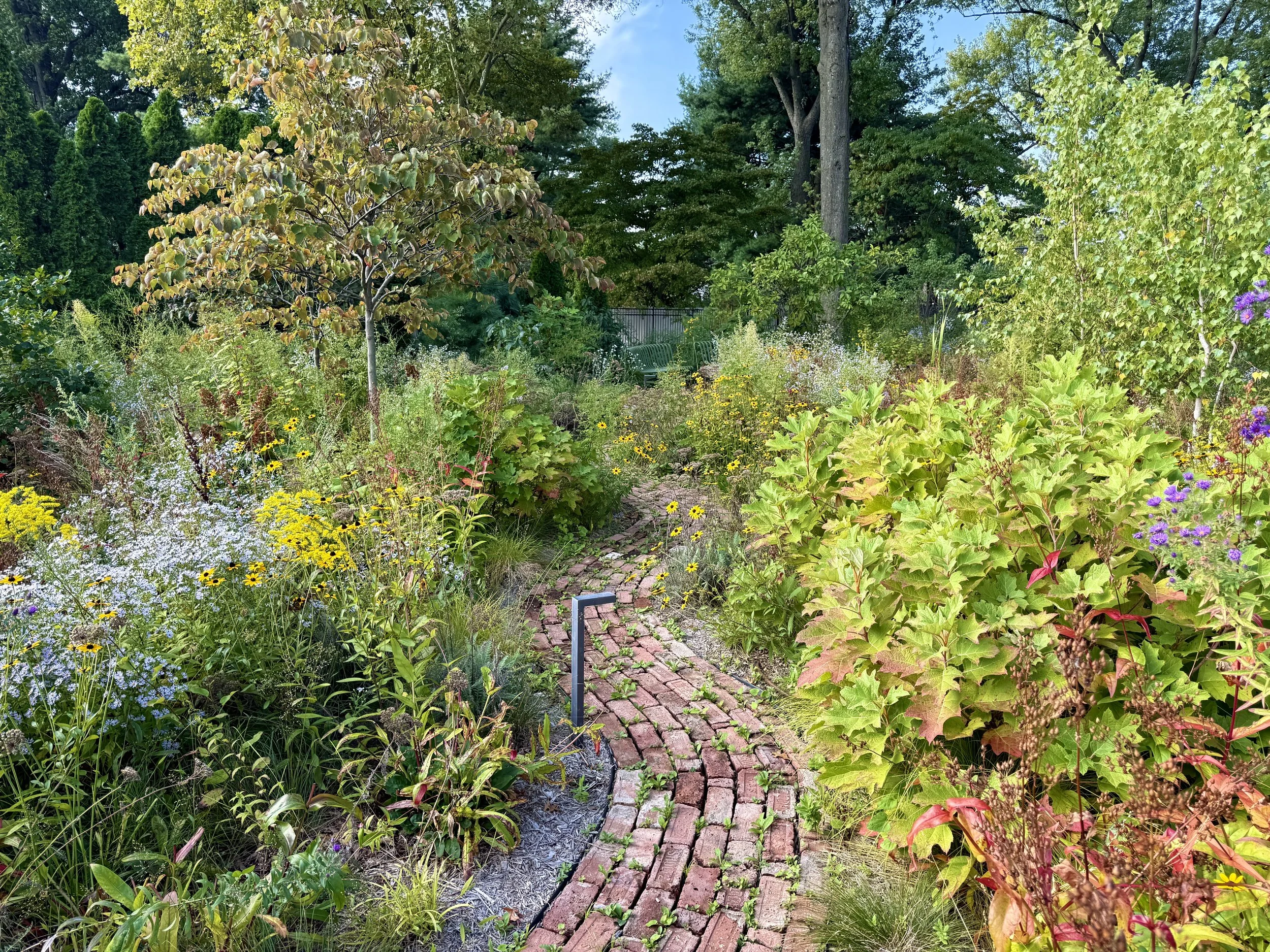
Within two years of planting, this garden requires minimal maintenance, as the layered plant material reduces weeding everywhere except along the path system. A string trimmer can be run over the brick paths a few times during the year to control growth along the footpaths, or the vegetation can be left to grow in for a more natural look.
Designing for Reduced Maintenance
“Right Plant, Right Place”
At its core, reducing maintenance begins with careful plant selection.
In the Northeast, this often means drawing from a palette of plants that are adapted to regional conditions. For dry, sunny exposures, species such as little bluestem (Schizachyrium scoparium) or prairie dropseed (Sporobolus heterolepis) thrive with minimal input. In shaded woodland conditions, plants like Pennsylvania sedge (Carex pensylvanica) or Christmas fern (Polystichum acrostichoides) establish a stable ground layer that requires little intervention once established. When plants are well-suited to their environment, they require less watering, are more resistant to pests (as they are not under stress), and grow at a manageable pace.
This principle is simple, but it is one of the most effective ways to reduce long-term maintenance.
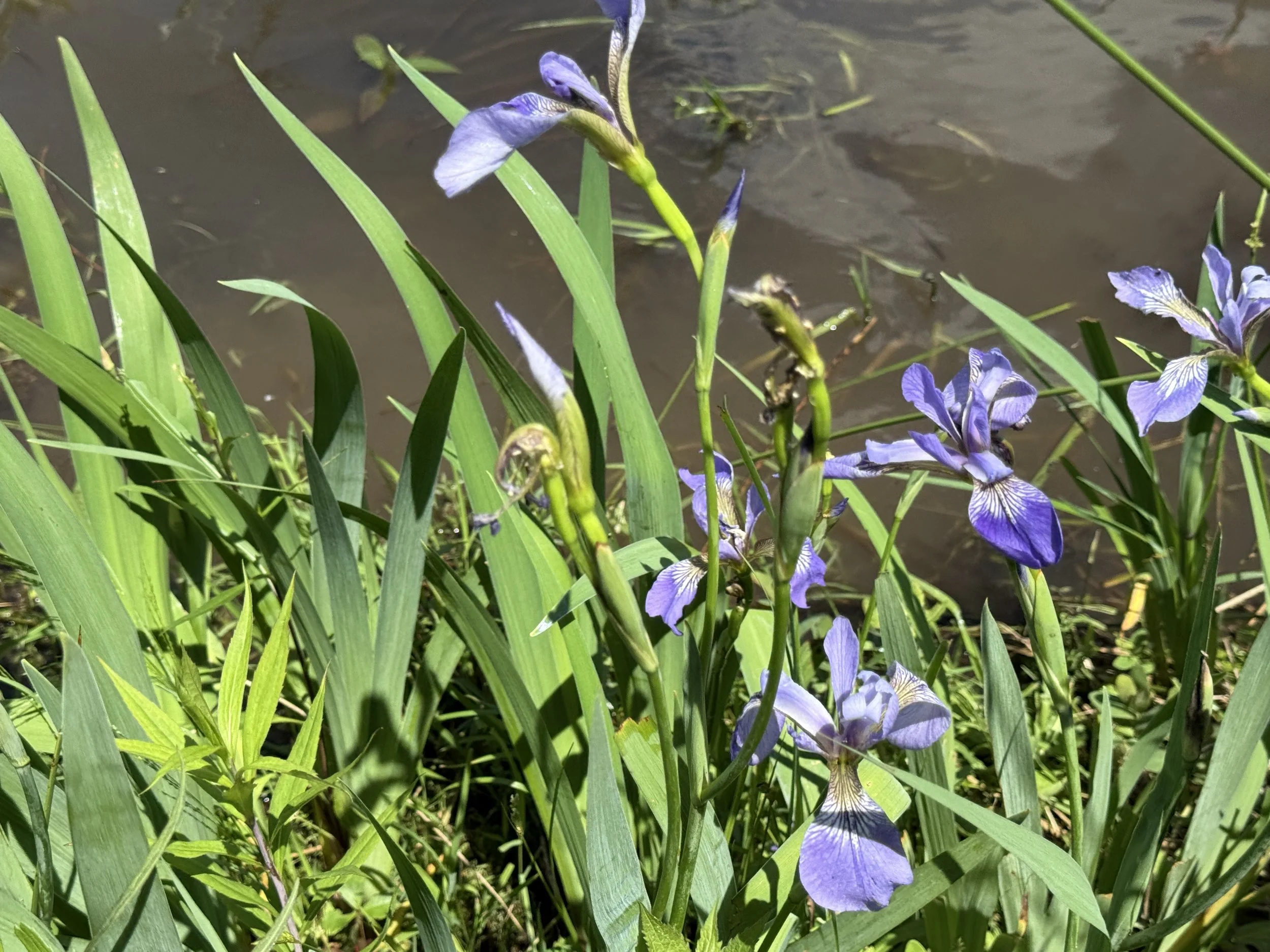
Iris versicolor naturally blooms in the Catskill Mountain in a hydric (wet) site in the middle of June. Right plant, right place.
Layering to Create Stability
In natural systems, plantings exist in layers, each contributing to the overall function of the landscape. A Northeast woodland edge, for example, might include canopy trees such as oak (Quercus) or maple (Acer), understory trees like serviceberry (Amelanchier) or dogwood (Cornus florida), shrubs such as witch hazel (Hamamelis virginiana) or arrowwood viburnum (Viburnum dentatum), and a ground layer of ferns and sedges.
This layered structure:
Shades and protects the soil
Retains moisture
Suppresses weeds
By reducing exposed soil, it minimizes the need for mulching and ongoing weeding while creating a more immersive spatial experience.
Building and Preserving Living Soil
Healthy soil is the foundation of a low-maintenance landscape. In ecological planting, fallen leaves and plant material are allowed to decompose in place, gradually building soil structure and fertility. This is particularly valuable in Northeast landscapes, where leaf litter from deciduous trees plays an essential role in nutrient cycling. Over time, this process:
Improves water retention
Supports beneficial soil organisms
Reduces the need for fertilizers
Plants such as oakleaf hydrangea (Hydrangea quercifolia) and foamflower (Tiarella cordifolia) are especially well adapted to these conditions, thriving in rich, organic soils.
Rethinking the Role of Lawn
Lawns are often the most maintenance-intensive element within a landscape. In the Northeast, they require frequent mowing, irrigation during dry periods, and ongoing weed control. Reducing lawn area—and replacing it with ecological planting—can significantly decrease maintenance while enhancing biodiversity.
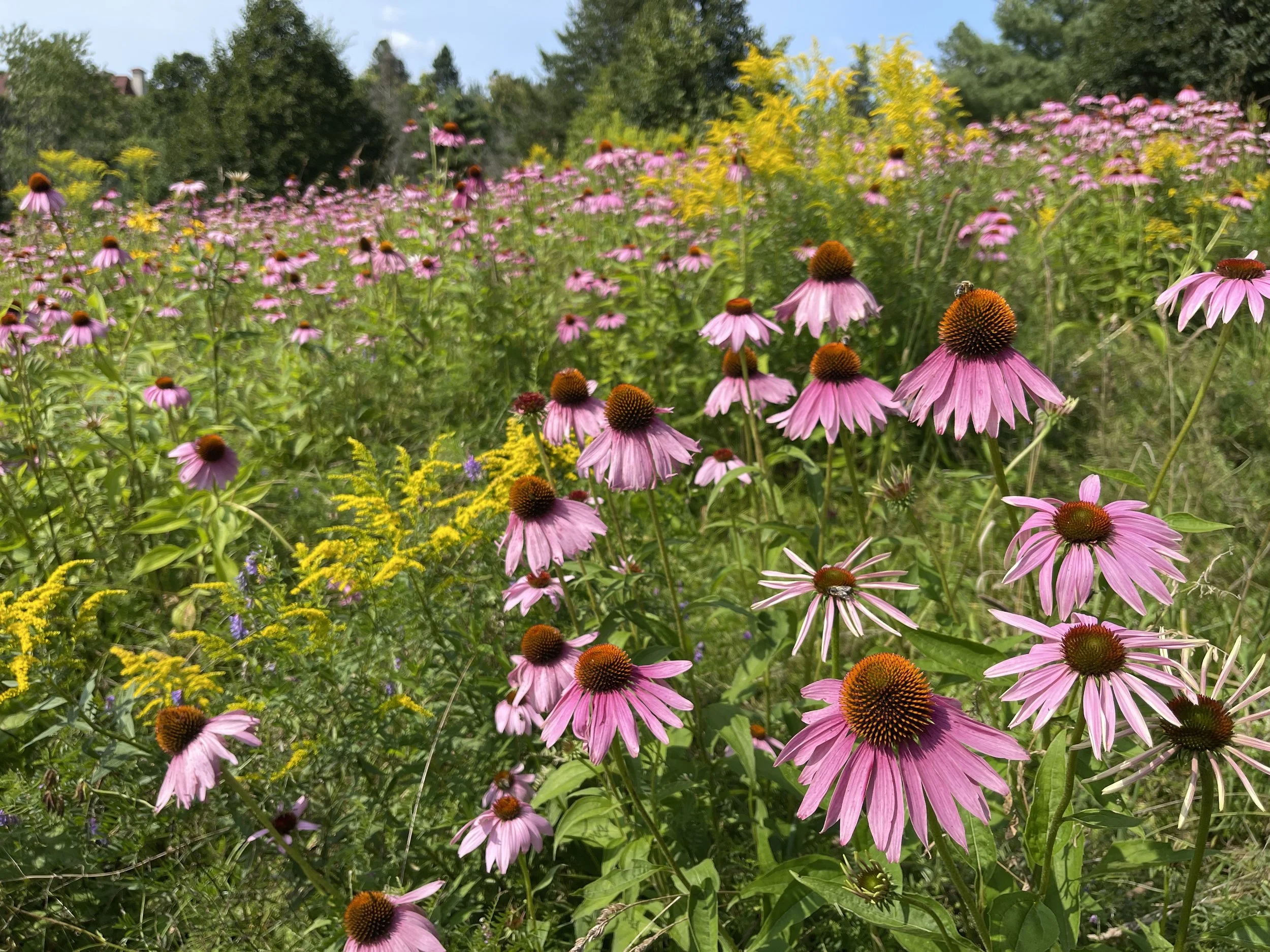
Meadow-inspired plantings using species such as switchgrass (Panicum virgatum), purple coneflower (Echinacea purpurea), and black-eyed Susan (Rudbeckia hirta) provide seasonal interest, support pollinators, and require far less intervention once established. The shift is not simply aesthetic; it changes how the landscape performs.
Designing Plant Communities, Not Isolated Elements
When plants are arranged as a community rather than as individual specimens, they begin to support one another. Diverse plantings are more resilient to environmental stress and better able to adapt to changing conditions. In the Northeast, where humidity, seasonal rainfall, and temperature fluctuations can contribute to plant stress, this diversity is particularly important.
For example, combining species such as inkberry (Ilex glabra), bayberry (Myrica pensylvanica), and little bluestem creates a planting that is both structurally diverse and adaptable to coastal or sandy soils. This interconnectedness reduces the need for intervention and allows the landscape to evolve more naturally.
Maintenance as Stewardship
Ecological landscapes are not without maintenance—but the nature of that maintenance changes. Rather than constant upkeep, the work becomes more seasonal and intentional:
Cutting back meadow plantings in late winter or early spring
Selectively thinning shrubs as they mature
Allowing seed heads and grasses to persist through winter for structure
In the Northeast, this seasonal rhythm adds another layer of interest, as grasses, perennials, and seed heads provide texture and movement well beyond the growing season.
Maintenance becomes less about control and more about guiding the landscape over time.
A Different Aesthetic
There is a common perception that ecological landscapes are informal or unstructured. In practice, they are carefully composed. Structure is created through massing, repetition, and spatial definition. Clean edges, pathways, and transitions help frame more naturalistic plantings, allowing them to feel intentional rather than unmanaged.
The result is a landscape that reflects the character of the Northeast—seasonal, textural, and deeply connected to its surroundings.
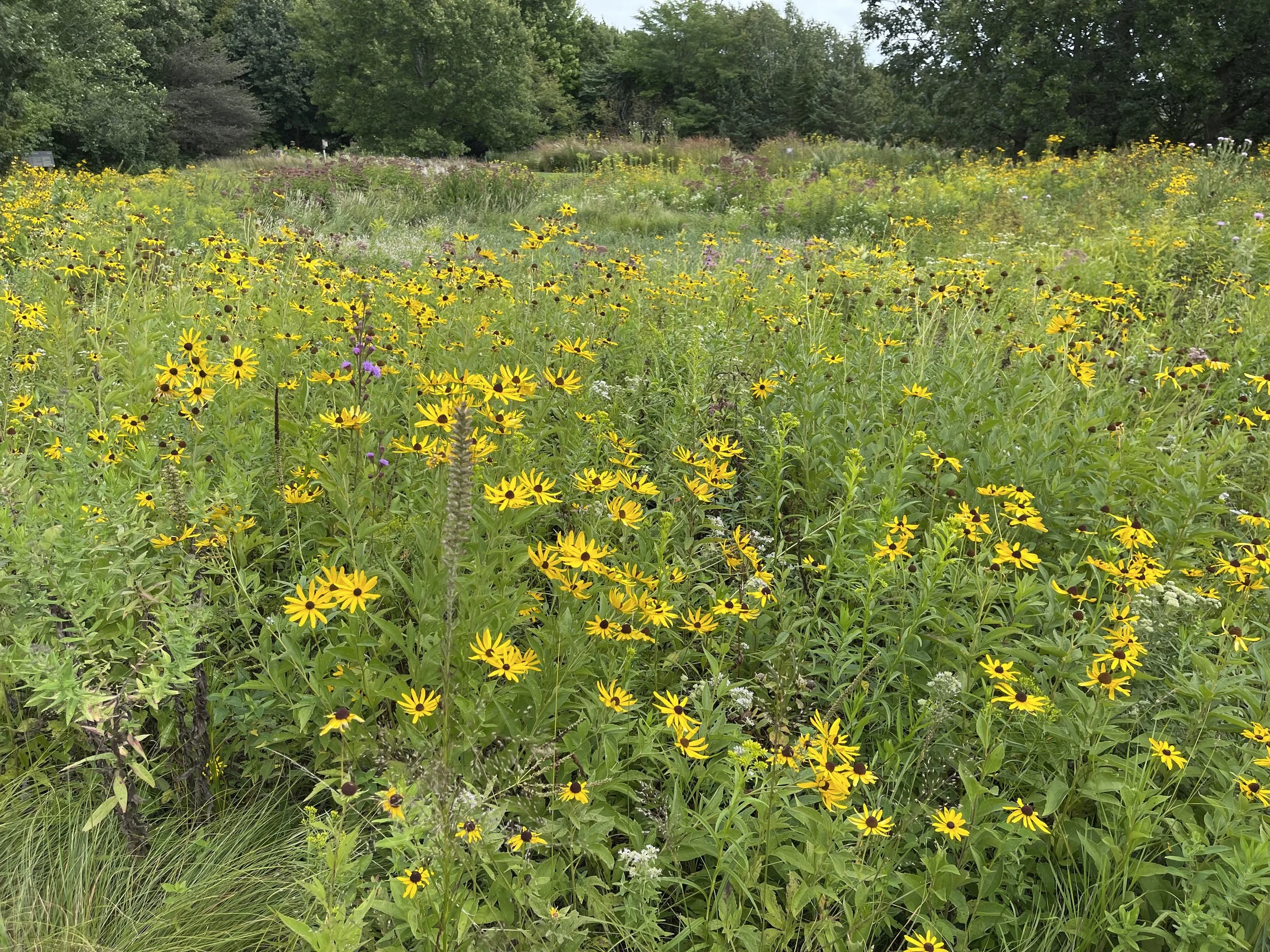
This Landscape at the University of Wisconsin Arboretum designed by Darrel Morrison was planted twenty years ago. It thrives with succession.
Long-Term Performance
Over time, landscapes designed in alignment with ecological principles become more stable and self-sustaining. They require fewer inputs, respond more gracefully to environmental variability, and offer a richer experience throughout the seasons—from spring ephemerals to autumn color and winter structure. Plants such as red maple (Acer rubrum), sweetspire (Itea virginica), and fothergilla (Fothergilla gardenii) provide dynamic seasonal change while remaining well adapted to regional conditions. Perhaps most importantly, these landscapes shift the relationship between people and place—from one of constant management to one of observation and engagement.
Final Thought
Reducing maintenance is not about simplifying a landscape—it is about deepening its logic. By working with the inherent conditions of a site, rather than against them, ecological planting design creates landscapes that are more resilient, more immersive, and more enduring.
In the Northeast, where landscapes are shaped by seasonality, soil variability, and a rich ecological context, this approach allows the garden to become something more than a designed space—it becomes a living system. One that, over time, requires less from us while offering more in return.
