
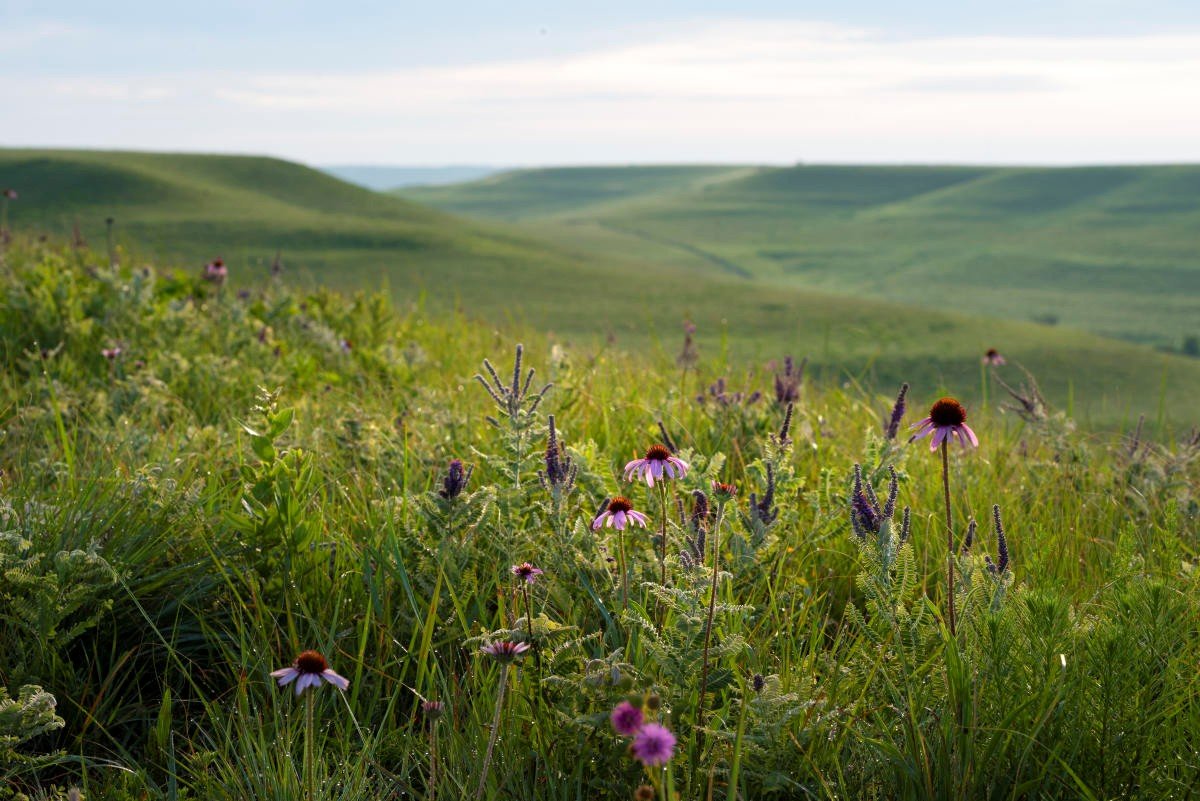
Once stretching uninterrupted across the heart of North America, the tallgrass prairie is now among the continent’s highly diminished and least recognized ecosystems. This past summer, I traveled to one of America’s most unassuming yet astonishing landscapes, where less than four percent of it’s original 140 million acres remain, surviving primarily in the Flint Hills of central Kansas. This persistence is not the result of deliberate preservation, but rather reflects the region’s underlying geology and steep terrain which made large-scale agriculture impractical. Elevated above a sea of wheat, corn, and soybeans, these remaining prairies endure quietly, harboring remarkable ecological complexity and historical memory within a landscape otherwise transformed by human activity.
Driving from Kansas City, to the Flint Hills, the scenery along I-70 set the stage for what lay ahead. The route began amid vast expanses of developed farmland, where neat rows of crops and human intervention dominated the horizon. Yet, as I continued westward through Topeka and into the Flint Hills, the landscape gradually transformed. Modern agricultural patterns gave way to an unspoiled rolling vista, a poignant reminder of the Great Plains as they existed before widespread development. Interestingly, aside from this dramatic shift, I identified only two physical demarcations of this place: one for the Flint Hills region and another for Konza. Beyond these sparse markers, there is little overt celebration of the land’s unique heritage and ecological value, leaving its significance to be discovered quietly by those who explore it.
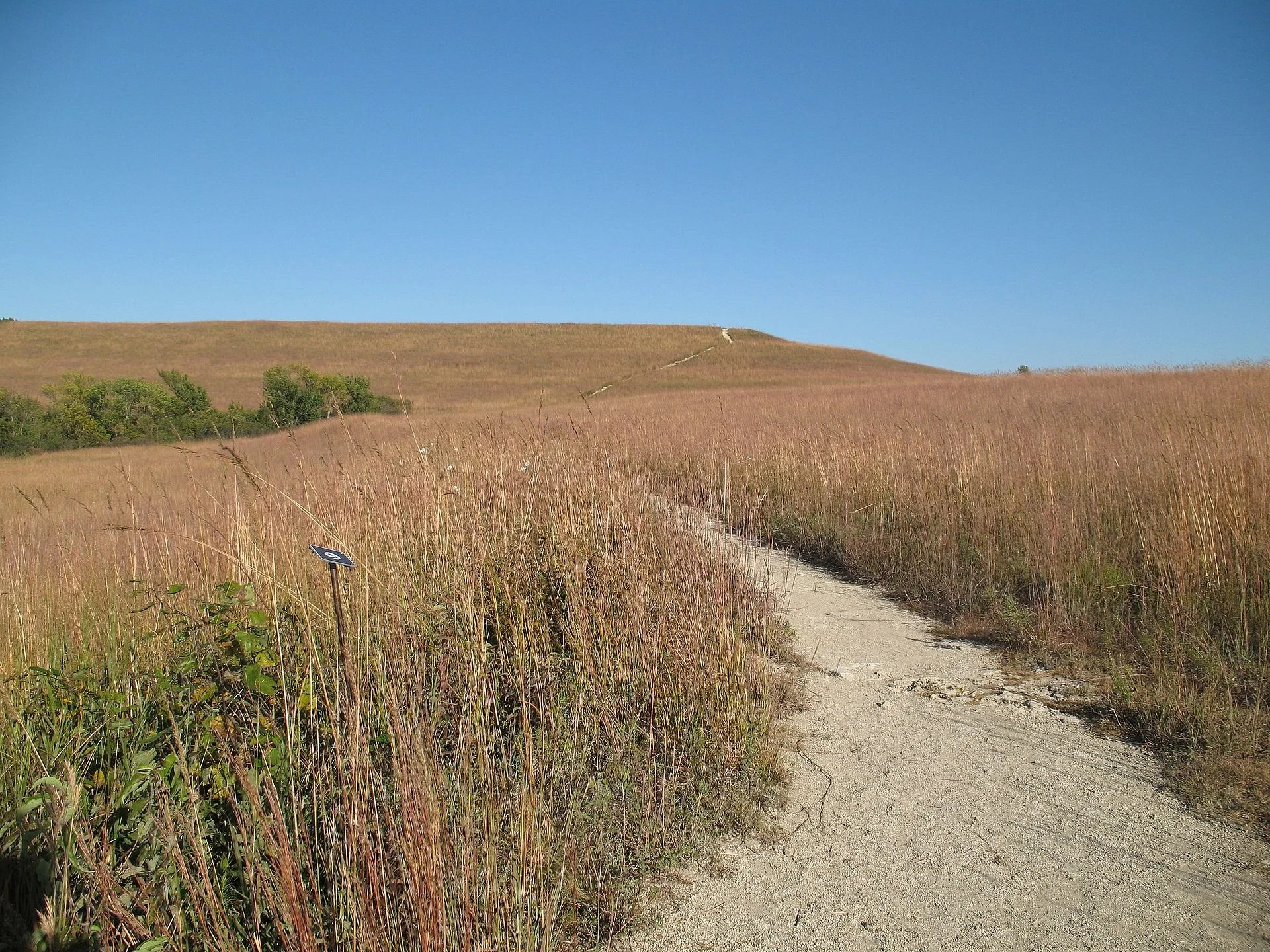
“At first glance the tall grass prairie appears monotonous. When seen from a passing automobile , the vast expanse is interrupted only occasionally by ribbons of forest that wind along streams and creeks. It is not until one peers into the prairie, rather than at it, that is true nature, it’s complexity and diversity, is revealed. In a tall grass prairie, most of the action takes place on a small scale, within patches hidden under the canopy grass. (Reichman - Konza Prairie - A Tallgrass History)
Discovering the Konza Prairie
Konza is an 8,616-acre section of the Flint Hills that functions as a biological research station operated by Kansas State University. Named for the indigenous Kaw (or Kansa) people whose history in the region spans centuries before their forced removal between 1846 and 1872, the prairie carries both deep ecological and cultural significance. This preserved landscape is home to an incredibly biodiverse ecosystem, with over 500 plant species, 250 vertebrates, and 700 insect species contributing to a vibrant and dense tapestry of life.
Kansas State University has generously made this area accessible to the public via a network of trails. Along these paths, educational signs highlight the conservation efforts and rich history of the site, inviting visitors to engage with the natural processes that continue to shape this remarkable environment.
A Showcase of Ecological Processes
At its heart, Konza is an open-air demonstration of nature’s intricate workings. Unlike managed gardens, this landscape has evolved through generations of adaptation. Periodic fires and grazing by herbivores are not disruptions but essential mechanisms that maintain the delicate and dynamic balance of the prairie. (See Kaity’s blog post on carbon sequestration and grasses) These processes recycle nutrients, stimulate regrowth, and preserve the open, sunlit conditions that many prairie species depend on for survival.
An Immersive Tapestry
The landscape at Konza is defined by rolling plateaus interspersed with vernal pools and streams, creating a patchwork of microhabitats that foster rich biodiversity. Throughout my hike I was consistently struck by the sheer abundance of natural processes on display and the resultant multi-sensory effects. Grasshoppers flitted about, lizards ran along the path I was hiking. I witnessed and heard countless different pollinators and birds. The space of the prairie itself hummed with activity.
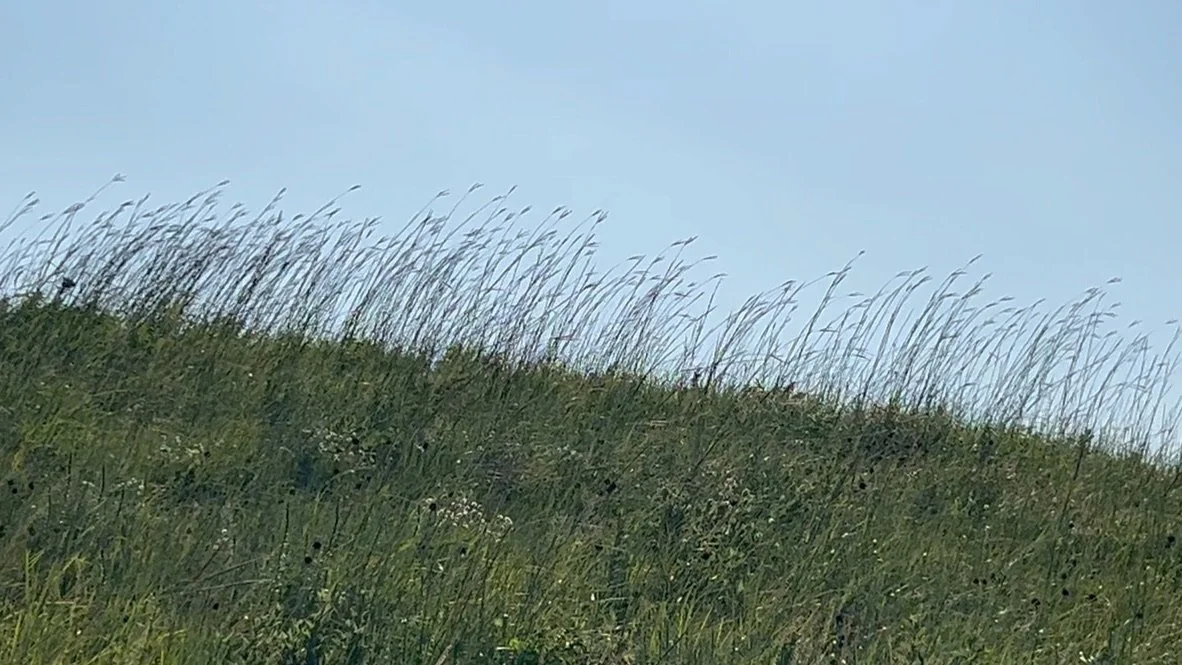
One of the most self-evident features of the prairies is how exposed to the sky it is. In Konza, the drastic elevational changes provide a series of lookouts from which to observe its vast scale and complexity. But perhaps the most forcefully perceptible element on display due to this openness is the wind. Which blows freely and intensely across the prairie, carrying pollen and seed and animating the entire landscape. One cannot help but be aware of how integral its function is in this ecosystem as every plant and animals existence is sculpted by it.
“Although grasslands occur all over the world, the North American tall grass prairie is special because of the magnitude of big bluestem grass, it’s dominant variety, which symbolizes the tall grass prairie. In a good year, big bluestem sends up a flowering stalk over 10 feet tall, producing what has been described as inland sea, complete with undulating waves, eddies, and the hiss of surf. During the growing season, the surface of the prairie writhes in response to the slightest breeze.” (Reichman - Konza Prairie - A Tallgrass History)
Dynamics of the Prairie
Each individual plant at Konza exhibits a distinct roughness, a quality that reflects the challenges of its environment and stands in stark contrast to their nursery grown counterparts.
Tallgrass prairies endure extreme seasonal variations, with intense, dry summers juxtaposed against freezing cold winters. Native grasses such as big bluestem, little bluestem, and switchgrass have adapted extensive root systems that extend several feet into the soil. These roots secure the plants against fierce storms and relentless prairie wind, allow them to access deep soil moisture during prolonged drought, and enable survival through periodic fires.
Biologists use the term “biomass” to describe the weight of life of a place. Life in the tropics, for instance, manifests itself as forests, and there almost all of the weight of life is in the trees’ trunks, almost none in the roots. - In grassland, the vast majority of biomass rests in roots. They are the center of the life of the place, and all else flows from them. In grassland, above-ground attacks are tolerated, but destruction of the roots is destruction of the place.” (Manning - Grassland)
Fire, in fact, plays a pivotal role in a tall grass prairie. Many native species have evolved traits that allow them to withstand and even thrive after periodic burns. Species like indian grass and sideoats gramma benefit from the nutrient-rich conditions that follow a fire, which helps them maintain their dominance in the landscape while preventing the encroachment of woody plants.
Complementing the grasses is a vibrant array of wildflowers and forbs. Prairie coneflower, blazing star, milkweed, and prairie clover are just a few examples that punctuate the landscape with bursts of color and texture. Their flowering cycles are closely synchronized with local pollinators, ensuring effective reproduction and bolstering the ecosystem’s resilience. This diversity not only supports insect populations but also helps maintain the overall balance of the prairie.
CONCLUDING THOUGHTS
The Konza Prairie stands as a crucial reminder of the importance of conserving natural landscapes amid rapid urban development and agricultural expansion. Preserving this intact tallgrass prairie safeguards a living archive of the region’s original ecosystem, a resource that is invaluable for both ecological research and public education.
“One learns to read the world of grass by tracing its various species. Grasslands have cultures, or races of inhabitants that vary with the surrounding land. The cultures begin and manifest themselves in the species of plants, but reverberate throughout the animal world, including the human world. Grass is a map of the landscape that reveals the land’s secret, it’s subsurface, it’s seasons, it’s time, it’s inhabitants” (Manning - Grassland)
- post by Kyle Schroeder
